COVID-19—reopen the office policy

COVID-19—reopen the office policy

We want to share with you below what we are doing to help maintain a healthy and safe environment, in addition to following guidelines from the CDC and regional public health agencies.

  • You are pre-screened on the phone when making an appointment for possible COVID-19 symptoms, air travel history, and exposure to anyone who has symptoms of COVID-19 regardless of testing, and recovering status if you had COVID-19.
  • When you arrive for your appointment, we will pre-check you for temperature as well as asking you the above questions again.  We will give you an opportunity to sit and relax in our specifically designed physical distancing waiting room. We will usher you promptly to your treatment room when possible.
  • We will be wearing masks during your visit for your protection.  We frequently disinfect all surfaces throughout the office. We disinfect each treatment room after every single visit or use.
  • We have rearranged our office space to ensure and encourage social distancing for both our employees and our patients.
  • We are asking for credit cards to be on file for all appointments and herb orders for faster and touchless checkout. We are also asking for your email address so we can email you receipts/superbills and communicate important information.
  • Please dress properly for your treatment including using a face mask out on the street for your own protection.  We may not be able to provide you with a facial mask since we have a limited supply.

Thank you for collaborating with us in providing a safe and healthy environment for all. If you have any questions, please do not hesitate to ask


Abdominal Massage Techniques

                                Abdominal Massage Techniques

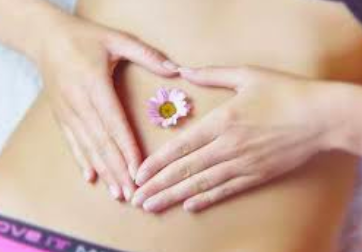
Have you ever had abdominal massage with our licensed massage therapist Katie Depre? People are about her massage therapy.  This is a service we provide at Mind Body Spirit Acupuncture Center. Abdominal Massage is an ancient method designed to facilitate the fertility, improve digestion and overall health. Paired with acupuncture and herbal medicine, this focused massage will encourage blood flow to the uterus, improve function of the abdominal organs, increase nutrient absorption, and stimulate the vagus nerve. Also, it feels good! The benefits of abdominal massage are not only limited to fertility patients, it is beneficial to most everyone’s health. You can try it for digestive issues, tension, anxiety, insomnia, to maintain or promote wellness, among many other health concerns. There are a few contraindications for this type of massage, so please discuss your health history with your therapist. Abdominal massage should not be done during periods of, and not limited to: acute abdominal pain, recent surgery in the area, risk of abdominal aneurysm, with metastasizing cancers of abdomen or reproductive system, or with a recent history of bleeding from the gastrointestinal tract or rectum. It is not recommended to work over the area of an IUD implant as well so not to move the IUD out of place or cause scarring.

What is so great about abdominal massage is that it is easy to do on yourself! We encourage patients to make this part of their daily routine to maximize its benefits. As always, if you have any questions or concerns, we are here to help. You can always book an appointment for a massage and your therapist will walk you through the steps until you feel comfortable doing this on yourself. And of course, it’s always nice to RECEIVE this massage so you can just lay back, relax, and enjoy.

Here’s a list of things you’ll need to get started: a comfortable place to lay down (should be a comfortable warm temperature, without a draft), oil or lotion (oil-based lotions are best, water-based lotions absorb too fast and become sticky), and a bolster for under your knees and under your head and neck (pillows work great, or you can use a variety of yoga bolsters). That’s it! You can upgrade your experience with adding relaxing music, a heating pad under your low back, or by adding in some essential oils. You can easily use some oils you may already have at home: consider olive oil, coconut oil, or grapeseed oil. It’s always best to do a small patch test for allergies before using anything over your entire abdomen. When choosing an essential oil to add, you want to choose something with either a warm or cold nature depending on your constitution. The idea is to balance the body, so if you have what chinese medicinal theory would call “cold in the uterus,” you would want to choose a warming oil. This is a great thing to come into the office and discuss with us. The first step to treating an illness is always diagnosis. Only then, can the appropriate treatment be determined. With this information, you can be confident with using the most appropriate essential oil.

After you have gathered all your supplies, you can begin. I do advise emptying the bladder before starting. Ideally, you are doing this without a full stomach, but also not while you are hungry. During the abdominal massage, more blood will head into the abdomen, so you want to make sure you are not feeling light headed before, and stop the massage if you become light headed. Ok, let’s talk about pressure and pace. A moderate pressure is advised, unless otherwise stated in the steps below. Moderate pressure will feel comfortable, firm, and will not cause pain. The pace should be relaxed, and slow enough that you are able to sense what is under your fingers. Feel for areas that seem tighter than others. This may feel like the tissue is denser or harder. These areas may need a little more attention. Everyone holds their stress in different ways, so it is good to become familiar with your holding pattern. Remember to trust yourself!

There are many different sequences I’ve come across. I will list out a way to start, so that you can become familiar with how to work the different areas of the abdomen, but know that you can personalize these steps to fit your needs, which may change. Customize this massage to fit your current needs whether that means the changes you experience during a cycle, meeting your digestive needs, changing pressure depending on if you want more of a relaxing session or a deeper fascial release, among others.

Step 1: Apply oil to the abdomen. You will likely need less than you think, and it is a little easier to add more than to take oil off the abdomen. You can have your oil in a small bowl nearby to make it even easier to dip your fingers into to reapply oil. Cover the entire area from the ridge of the ribs down to the pelvic and pubic bones.

Step 2: To position the hands, put your four fingers on each hand together, thumbs to the side, and place one hand over the other (both hands will be at a 45 degree angle.) Your hands will make a shape that looks like a pointed shovel. Tuck the thumb on the upper hand under the thumb on the lower hand. You may want to experiment with having your dominant hand be the bottom and the top hand, and you can switch during the massage if one hand gets tired. Your hands will get stronger as you do this more often, and it will become easier. If this part is confusing, there are plenty of videos online that demonstrate the hand position. Also, if some other hand position works better for you, try it out!

Step 3: Start by working in circles around the belly button. Widen your circles with each pass around the belly button. Really try and feel the tissue under your fingers for any tension. If you do find tension, spend some time working over that area in very small circles until it softens. It is good to work in a clockwise motion. Imagine noon as your sternum, and 6pm as your pubic bone. This way, your hands are following the direction of the bowel through the large intestine. This is especially good to do if you experience constipation. Massaging in a clockwise direction will assist the natural movement of the bowels, and even encourage movement in a lazy bowel. If you are experiencing diarrhea, you can work in a counter-clockwise position to slow the frequency of a loose stool. Remembering our contraindications from before, abdominal massage isn’t recommended for acute abdominal pain. If the diarrhea is severe, you’ll want to take another course of action. You can repeat these circles over the entire abdomen a few times, until you feel like the tissue is warmed up and loose. Try three times to start and go from there.

Step 4: To stimulate the uterus: with your index fingers, locate the pubic bone and rest your fingers against it. You may feel a slight indent. Close your eyes and feel around the top until you have found that indent, this will be your starting place. Place your index fingers on the indent and begin to sink deeply into the soft tissue of your pelvis just above the pubic bone. Dig deeply here. If your uterus is in position, you will feel a deep empty space with no resistance. The dropped uterus feels like a balloon filled with water and gives a good deal of resistance to your pressure. Keep massaging deeply in an upward motion toward the umbilicus 9-10 times. You only need to go up 2-3 inches. In the 2-3 days before your menses, it is best to work in a downward position, so as not to work against the natural flow of your cycle. I recommend not doing the massage during the menses. I have personally found some light touch over the uterus during times of intense cramping will help ease the discomfort, but it’s best to avoid any deep work. We always want to work upward after ovulation to encourage the implantation of the egg. Working over the area of the uterus will bring fresh blood flow to the uterus, help flush out cell waste, and with new blood comes nutrients to enrich the tissue.

Step 5: With your pinky fingers, put one on the pubic bone and the other on the hip bone. Find the middle spot, which should be soft and not uncomfortable. With the same hand position, stroke towards your midline and up slightly. You will be making a “J.” Do this about 9-10 times, and repeat on the other side. Here we are working the ovaries and fallopian tubes.

Step 6: Placing your hands just below the sternum, massage down the midline to the belly button. Pause and do small circles over any area of tension. Here, you will be working over the stomach and small intestines. This is also the Ren meridian in Traditional Chinese Medicine. The Ren meridian is also called the mother line, it is a reservoir for the Yin of your body, and can be treated to treat emotional imbalances relating to bonding. This is a great area to work to stimulate the Vagus Nerve which will relax your nervous system into a parasympathetic “rest, digest, and repair” state. This state is opposite the sympathetic “fight or flight” stress state we are so often experiencing. The body needs to spend time in the parasympathetic state to properly absorb nutrition, do internal repairs, perform certain roles of the immune system, and to increase the lining of the uterus. Other lifestyle choices will guide you into this state as well including, but not limited to: meditation, certain types of movement, and acupuncture.

Step 7: Starting again just below the sternum, this time angle your fingertips to run along the ridge of the ribcage. We are going to work from the sternum to the lateral aspect of your abdomen a few times on each side. The liver is on your right side, while the spleen is on the left. These organs perform many essential functions and will benefit greatly from massage as well.

Step 8: Now that you have covered the entire abdomen, you can do some gentle strokes with flat palms. You can use light strokes that go only skin deep to help flush the lymphatic system of all the waste products we cleared from deeper tissues during the massage. Do a few circles around the abdomen gently to finish up. You’ll want to stay lying still for a few moments. This is the perfect time to do some deep breathing, as moving the diaphragm also helps move the lymph fluid. Remember to get up slowly as some people can feel a light headed after a massage. You can roll to one side and slowly raise yourself to a seated position. Rest in a seated position until you feel steady enough to stand.

Ok! How do you feel? I hope relaxed and refreshed. While this step by step instruction can help you feel more comfortable performing self-massage at home, it is not intended to self-diagnose. Please come on into the office so we can help you find the right treatment for your health goals. We are trained and ready to educate and empower.

By Kathryn Depre

April, 2020

Please join me free live online Qigong and Taichi classes


Please join with me for  New, Live Zoom Free Qi Gong/Tai Chi Classes on  Wednesday/Fridays/Mondays 4/22/2020 from 5:30-6:30 pm

Follow me to practice the following exercises
1. Meridian Tapping Techniques for health and immune boost( 经络拍打功)
2. Six Unity Qigong ( 养生六合功)
3. Shaolin Six Harmony Qigong(少林六合功)
4. 8 Trigram 5 steps Taichi Routine ( 太极八法五步)

Dr. Jiling hu is inviting you to a scheduled Zoom meeting.

Topic: Traditional Chinese Healing qigong and Taichi Exercise
Time:  05:30 PM Pacific Time (US and Canada)
Every week on Mon,  Fri, until May 15, 2020
May 4, 2020 05:30 PM
May 8, 2020 05:30 PM
May 11, 2020 05:30 PM
May 15, 2020 05:30 PM
Please download and import the following iCalendar (.ics) files to your calendar system.
Weekly: https://zoom.us/meeting/tJwocOCgqjstE9YcR7XT8qM4_M3Hv6ymdnZ2/ics?icsToken=98tyKuCgqzwjEtCVtxCFRow-GY_CXfzwiGJaj_pkny2yOxQLcy6iCc8RGqQpCdXU

Join Zoom Meeting
https://zoom.us/j/98579840792?pwd=STViVVpYRFJlMUI5Tjc1OGNycmlQdz09

Meeting ID: 985 7984 0792
Password: 604079

Meridian tapping Techniques for chi cultivation and immune boost

Click here watch the video

  1. Rub the palms together until warm, then put your hands over your face and eye area, then “wash” your face with your hands, repeat 3 times
  2. Rub apart the eyebrow
  3. Rub the both side of inner canthus
  4. Rub the nose bridge
  5. Rub LI11(outside of both nostrils)
  6. Rub St2(directly below the pupil of the eye, in the depression at the infraorbital foramen)
  7. Rub Taiyang ( Temple area)
  8. Rub SJ21 ( Ear gate–in the depression anterior to the supra-tragus notch)
  9. SJ17 (Wind screen depression area in the posterior to back of earlobe)
  10. Rub points St7, ST6 (Masseter muscle area) on the side of your cheek on TMJ joint and biting muscle area)
  11. Rub LI18, SI16 (posterior and interior of SCM on the nape)
  12. Pull and rub on ear apex
  13. Pull and rub the middle of auricle
  14. Pull down and rub ear lobe
  15. Tapping on the inside of arms (3 hand yin meridians) away from shoulder to hand
  16. Tapping outside of arms (3 hand yang meridian) away from hand to shoulder
  17. Tapping inside of leg ( 3 three yin meridian) from ankle to inguinal area
  18. Tapping  outside of leg (food yang meridian)  from hip to ankle
  19. Tapping on the LI4 (Tiger Mouth) ( crossing  tap on the web between thrum and index finger)
  20. Cross tapping Extra points Ba Xie ( eight pathogen- crossing tap webs between fingers)
  21. Tapping with fist on the Lung1 (Central palace-top of chest where meets the shoulder)
  22. Tapping  on Liver 14 (Gate of Hope– 6th intercostal space under the breast)
  23. Taping on the Ren22-Ren17 ( Window of sky to sea of qi –Finger tapping along the sternum from throat area down to the center of chest)
  24. Tapping on ST25 (Heavenly Pivot- about fist width from umbilicus ) and UB23 (Kidney Hollow-kidney area-) front side and backside at same time
  25. Tapping on the ST30 (surging qi point- inguinal area)
  26. Tapping on the GB31 (Wind City–side of thighwhere the tip of the middle finger touches)
  27. Tapping on GB21 (Shoulder Well-Top of shoulder)
  28. Tapping on DU14 (Nape area) with both hands
  29. Chop on LI10 (Arm 3 miles-forearm near elbow)
  30. Fist tapping on St36 ( fist distance below the center of knee cap)
  31. Finger Tap the SJ5 (external door-Lung) on both sides
  32. Finger n the PC6 (internal door-heart) on both sides
  33. Shake arms 9 times x 3

Function:  Acupressure and Meridian tapping helps body and mind connection   Stimulating the meridian points through  tapping can reduce physical tension and emotional stress,  relieve your stagnant energy,  and strength body resistant.   In TCM, we believe it promotes qi and blood, unblock stagnation in the channel and collaterals, expel pathogen and tonify vital qi.

Get ready. Relax the whole body, include neck, shoulder, arm, even fingers. Standing maturely, or you may also sit if you prefer. Using gentle but powerful force, even pace! Neither too soft or too hard.

The Ancient health cultivation qigong exercises.

Daoyin Liu He Gong ( Six Unity Gigong):

Click here to watch video

Preparation: Relax body and mind, stand naturally, listening your own breathing or rhythmic sounds. Slightly curl up your mouth corner , breath natural and have a peaceful mind

  1. Ascending and descending, opening and closing—bring clear yang qi into the body and remove turbid qi out
  2. Exhale the old and inhale the new—in six directions-Exhale the turbid qi and inhale fresh qi to achieve internal qi activity to unblock the meridian and harmonize the qi and blood
  3. Ascending the clear and descending the turbid-regulate internal organs, mainly exercise psoas, abdominal diaphragm and gastric muscles and guide qi flow, and exert a gentle massage on Liver, Spleen, Stomach and Intestines
  4. Turn the body to look back—strength psoas, ligament and spine, and improve functions of spine, strength the bone and Dai meridian, fortify the spleen and kidney
  5. Relax the fascia and stretch the body—Lateral pulling and extension of lower back and upper limb muscles, to unblock gallbladder meridian, alleviate back muscle tension and benefit the joints
  6. Leap on the horse to draw a bow—balance front and back, left right, up and down, and benefit the head, neck, limb, waist and abdomen, regulate three burner, unblock the water passage.
  7. Closing posture: Inducing qi to its origin.

The Baduanjin qigong

The Baduanjin qigong(八段錦) is one of the most common forms of Chinese qigong as exercise.[1] Variously translated as Eight Pieces of Brocade, Eight-Section Brocade, Eight Silken Movements or Eight Silk Weaving, the name of the form generally refers to how the eight individual movements of the form characterize and impart a silken quality (like that of a piece of brocade) to the body and its energy. The Baduanjin is primarily designated as a form of medical qigong, meant to improve health

Standing Ba Duan Jin

Click here to see watch video

Two Hands Hold up the Heavens (Shuang Shou Tuo Tian)

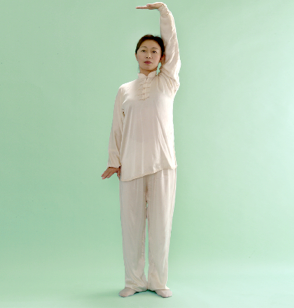
This move is said to stimulate the “Triple Burner” aka “Triple Warmer” or “Triple Heater” meridian (Sanjiao). It consists of an upward movement of the hands, which are loosely joined and travel up the center of the body.

Drawing the Bow to Shoot the Eagle / Hawk / Vulture

While in a lower horse stance, the practitioner imitates the action of drawing a bow to either side. It is said to exercise the waist area, focusing on the kidneys and spleen.

Separate Heaven and Earth

This resembles a version of the first piece with the hands pressing in opposite directions, one up and one down. A smooth motion in which the hands switch positions is the main action, and it is said to especially stimulate the stomach.

Wise Owl Gazes Backwards or Look Back

This is a stretch of the neck to the left and the right in an alternating fashion.

Sway the Head and Shake the Tail

This is said to regulate the function of the heart and lungs. Its primary aim is to remove excess heat (or fire) (xin huo) from the heart. Xin huo is also associated with heart fire in traditional Chinese medicine. In performing this piece, the practitioner squats in a low horse stance, places the hands on thighs with the elbows facing out and twists to glance backwards on each side.

Two Hands Hold the Feet to Strengthen the Kidneys and Waist

This involves a stretch upwards followed by a forward bend and a holding of the toes.

Clench the Fists and Glare Fiercely (or Angrily)

This resembles the second piece, and is largely a punching movement either to the sides or forward while in horse stance. This, which is the most external of the pieces, is aimed at increasing general vitality and muscular strength.

Bouncing on the Toes

This is a push upward from the toes with a small rocking motion on landing. The gentle shaking vibrations of this piece is said to “smooth out” the qi after practice of the preceding seven pieces or, in some systems, this is more specifically to follow Sway the Head and Shake the Tail.

8 Trigram 5 steps Taichi Routine ( Ba Fa Wu Bu-Taichi 13 postures)

Click here to see watch video

  1. Ward Off – Peng
  2. Roll Back – Lu
  3. Press – Ji
  4. Push – An
  5. Pull Down – Tsai
  6. Split – Lieh
  7. Elbow – Chou
  8. Shoulder – Kao
  9. Advancing Steps – Jin
  10. Retreating Steps – Tui
  11. Stepping to the Left Side – Ku
  12. Stepping to the Right Side – Pan
  13. Settling at the Center – Ding

The Thirteen Postures (8 Gates and 5 Steps) are referred to in various ways by T’ai Chi Ch’uan authors.  Some call them the “Thirteen Powers = Shi San Shi.”  Others call them the Thirteen Postures, the Thirteen Entrances, the Thirteen Movements, or the Thirteen Energies.

The most frequent references to the 13 Postures are in the writings and teaching in the Yang Style of T’ai Chi Ch’uan.

The first Eight Gates or Eight Entrances (Ba Gua or Pa Kau) can be divided into the Four Primary Hands (Ward Off, Pull Back, Press and Push) and the Four Corner Hands (Pull Down, Split, Elbow and Shoulder).

All thirteen postures, or course, involve some movement of the feet and legs, but the final Five Gates involve more extensive movements of the feet and legs.  These are collectively referred to as the Wu-hsing – Five Elemental Phases of Change.  The final five gates are associated with the 5 elementary processes (Wu-xing) involving:  metal, wood, water, fire, and earth.

Meridian tapping Techniques for health and immune boost

Meridian tapping Techniques for health and immune boost

Please clink here to see the video

Meridian tapping helps body and mind connection   Stimulating the meridian points through  tapping can reduce physical tension and emotional stress,  relieve your stagnant energy,  and strength body resistant.   In TCM, we believe it promotes qi and blood, unblock stagnation in the channel and collaterals, expel pathogen and tonify vital qi.

  1. Rub the palms together 36 times, then put your hands over your face and eye area, then “wash” your face with your hands
  2. Repeat step 1 three times
  3. Rub the eyebrow
  4. Rub the both side of inner canthus
  5. Rub the nose bridge
  6. Rub the both outside of nostrils
  7. Rub St7 , ST6 (on the side of your cheek on TMJ joint and biting muscle area)
  8. Rub LI18-SI16 (side of neck–Window of the Sky points)
  9. Pull and rub on ear apex
  10. Pull and rub the middle of auricle
  11. Pull down and rub ear lobe
  12. Rub the lower back
  13. Tapping on the front arms (3 hand yin meridians)
  14. Tapping back of arm (3 hand yang meridian)
  15. Tapping side of leg (food yang meridian)
  16. Tapping inner side of leg 9 times
  17. Tapping on the LI4 (Tiger Mouth) by crossing
  18. Tapping on the Baxie( Eight pathogens) ( Cross tapping, between fingers on webs) 
  19. Tapping on the Lung1 (Cloudy Door)
  20. Tapping on Liver 13 (Gate of Hope)
  21. Taping on the Ren22 (Heavenly Rushing)
  22. Tapping on ST25 (Heavenly Pivot) and UB23 (Kidney Hollow) frontside and backside at same time
  23. Tapping on the GB31 (Wind City)
  24. Tapping on the ST31 (surging qi point-The Sea of Water and Grain)
  25. Tapping on GB21 (Shoulder Well) on both side
  26. Tapping on DU14 (Big Bone) with both hands
  27. Tapping on the SJ5 (external door-Lung) on both sides
  28. Tapping on the PC6 (internal door-heart) on both sides
  29. Tapping on LI10 (Arm 3 miles)
  30. Tapping on ST36 (Leg 3 miles)
  31. Shake arms 9 times x 3


Traditional & Classical Chinese Health Cultivation QiGong

Traditional & Classical Chinese Health Cultivation poster

This is the “Tai Chi Health” series developed and issued by the WHO Traditional Medicine Cooperation Center-Shanghai University of Traditional Chinese Medicine: Chinese traditional health cultivation Qigong. Share to you for promoting physical and mental health.

Click here to learn more

Contents
一、Ba Duan Jin
二、Fang Song Gong (Relaxation Exercise)
三、Liu He Gong (Six-Unity Exercise)
四、Gu Yin Liu Zi Jue (Six Healing Sounds)
五、Song Rou Gong (Soft and Relaxed Exercise)
六、Xiao Yao Gong (Free and Easy Exercise)
七、Tian Zhu Dao Yin Gong
八、Yi Jin Jing (Chinese Transformation Classic)

Acupuncture for Integrative Oncology Support

The American Cancer Society has reported that half of all men and a third of all women in the United States will develop cancer during their lifetimes. Although there are many forms of cancer, all forms of the disease begin with abnormal cells that grow out of control.
Unlike other illnesses that are eradicated by the body’s natural defense system, cancer needs to be treated with powerful medical interventions. Unfortunately, most of the current cancer treatments available have some debilitating side effects.
Acupuncture and Oriental medicine have received much attention as an adjunctive therapy in cancer treatments because they address many of the unpleasant symptoms and side effects that come up during and after chemotherapy, radiation, biological therapy and surgery.
If you are currently undergoing treatment for cancer, acupuncture and Oriental medicine can provide real help by decreasing many of the side effects associated with conventional cancer treatments.

Some of the issues acupuncture can help with include:

    • Pain Management
    • Nausea
    • Stress
    • Fatigue
    • Depression and Anxiety
    • Dry Mouth
    • Night Sweats and Hot Flashes
    • Fluid Retention
    • Weight Maintenance

Acupuncture takes a holistic approach to health care and is particularly useful in providing pain relief, reducing the impact of side effects, accelerating recovery, and improving overall quality of life.

According to the National Cancer Institute, acupuncture may cause physical responses in nerve cells, the pituitary gland, and parts of the brain. It is proposed that, by stimulating physical responses in these areas, acupuncture positively affects blood pressure and body temperature, boosts immune system activity, and causes the body’s natural painkillers, such as endorphins, to be released.

To learn more about how acupuncture can safely and effectively be incorporated into an oncology treatment plan, call for a consultation today!

Science Provides Proof of Acupuncture’s Helpful Role in Cancer Therapy

Clinical trials have examined the effects of acupuncture on cancer as a disease, as well as the symptoms caused by cancer treatments. Results have shown that, for many patients, treatment with acupuncture relieves symptoms or keeps them from getting worse.

Relief for Nausea and Vomiting:
The strongest evidence of the beneficial effect of acupuncture has come from clinical trials that investigated its use for relieving nausea and vomiting. Several types of clinical trials using different acupuncture methods showed acupuncture reduced nausea and vomiting caused by chemotherapy and surgery.

Boosts the Immune System:
Human studies on the effect of acupuncture on the immune system of cancer patients showed that it improved immune system response, including an increase in the number of white blood cells.

Improves Pain Management:
In clinical studies, acupuncture reduced pain levels for some cancer patients. In one study, most of the patients treated with acupuncture were able to stop taking drugs for pain relief or to reduce their doses.

Relieves Pain and Stiffness during Hormone Therapy:
In 2010, the Journal of Clinical Oncology published the results of a small study that concluded that acupuncture helped relieve pain and stiffness in breast cancer patients who were simultaneously being treated with hormone therapies.

Minimizes Dry Mouth:
In 2009, the medical journal Head and Neck reported the results of a pilot study done at the University of Texas MD Anderson Cancer Center. The subjects were people suffering from head and neck cancer. The authors concluded that the pilot study demonstrated that acupuncture can improve the subjective symptoms of radiation-induced dry mouth as early as two weeks after starting treatment. They found that benefits can last for one month after treatment ends.

A study published in January 2000 in the medical journal Oral Diseases, confirms the efficacy of treating xerostomia with acupuncture and Oriental medicine. Researchers analyzed the data of 70 patients who suffered from dry mouth due to radiation therapies, Sjogren’s disease, and other causes. Researchers discovered that patients who received 24 acupuncture treatments had an outstanding improvement in their salivary flow rate (SFR) for up to six months after treatment. It was also concluded that continued acupuncture treatments could increase one’s salivary flow rate for up to three years.

Reduces Pain and Shoulder Dysfunction:
In 2008, Dr. David Pfister, chief of the head and neck medical oncology service at the Memorial Sloan-Kettering Cancer Center in New York City, reported that patients found significant reductions in both dry mouth and pain and shoulder dysfunction after neck dissection with the help of acupuncture. Dr. Pfister highlighted the potential role of acupuncture in oncology.

Reduces Hot Flashes:
In 2011 a Yale University/University of Pittsburgh study of women with hot flashes brought on by conventional breast cancer treatment, found that women who received acupuncture had a 30 percent reduction in hot flashes.

Acupressure for Nausea Relief

Nausea is an indicator that something else is wrong. Depending on the severity and duration of vomiting, some level of dehydration may occur. In severe cases, this may become a medical emergency. Small sips of warm water may help the patient stay hydrated or, if this is not tolerable, sucking on ice chips may help.

Here are three simple acupressure techniques you can perform at home to help alleviate your nausea.

1. Pericardium 6 (P6) or Inner Gate
To locate this point, place your hand with the palm facing up. Starting from the middle of the wrist crease, place three fingers down below your wrist. Your index finger should be in the middle of two tendons. If you are having trouble locating the tendons, flex your wrist and they should be displayed more prominently. Press Inner Gate lightly with the pad of your thumb. You can slowly increase pressure and go deeper into the point. Continue this exercise for up to five minutes if you are using heavy pressure. However, some people experience more relief from nausea when they continuously press with gentle to moderate pressure. If this is the case for you, it is safe to apply acupressure for longer periods of time. This may be especially helpful in cases of motion sickness.

2. Outer Gate or San Jiao 5 (SJ5)
If your nausea still persists, you can activate this partner point to Inner Gate. It is found on the opposite side of the forearm from Inner Gate. With your thumb on Inner Gate and your middle finger on Outer Gate, complete the circuit by squeezing the points together using moderate pressure. Hold for a few seconds and then release. This can be done for up to five minutes. If you feel you need a little extra self-care, you can place your hands near your heart, close your eyes, and breathe deeply as you perform this technique.

3. Abdominal Circular Motions
This exercise covers a larger area, and is less exacting. First, put your hands on your hips, at the level of your waistline. Next, adjust your fingers so they are all below your ribs, with your pinky resting around the level of your belly button. Your fingers should be lined up with the nipples. Press into the abdomen using circular motions and gradually expand your motions outwards for another couple of inches. This technique can be quite soothing and is best when performed sitting down, for two to three minutes.